The Hunt for Perfection

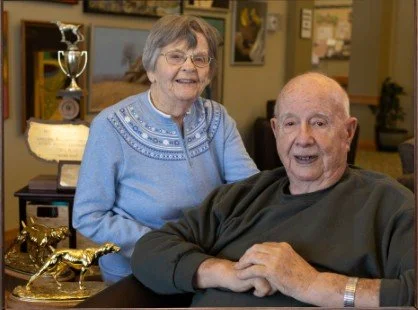
A Life Among Champions with Bob & Pat Merkel
Retirement looks different for everyone. Some ease into quiet mornings and unhurried afternoons. Others, like Bob, carry with them a lifetime of motion and momentum built from decades of grit, instinct and the relentless pursuit of excellence. For him, slowing down isn’t really slowing at all. It’s simply shifting gears.
Long before he became a nationally recognized dog trainer—before the trophies, the travel and the international acclaim—Bob was simply a young man with two passions: dogs and competition. What began as a personal interest soon became a calling, shaping the next half-century of his life. “I had done some amateur training,” he says, recalling those early days. “And I liked competition.” From that modest beginning grew a remarkable career.
Growing up, Bob never imagined he would train elite field trial dogs. He worked at the packing house, raised a family, and lived the life where you learn to work hard because that’s what the day requires. But the dogs kept calling. The competitions kept calling. And eventually, the two worlds collided. “We graduated from the packing house to train full time,” he says. “Competition was big, and we competed all over the country.” It was a working life that never stood still.
As his amateur wins stacked up, so did the attention. Dog owners began seeking him out. Not just for obedience or basic handling, but for something far more demanding: field trials, the sport that simulates real hunting conditions and tests a dog’s instinct, discipline and endurance.
These weren’t backyard contests. They were sprawling, day-long events across rugged terrain, with handlers on horseback and judges watching every move. “It was like a hunting simulator,” Bob explained. “You have two judges, two handlers and two dogs running all day.”
And the competition wasn’t just national. Dogs from Scotland, Germany, Denmark and across Europe came to compete. The field was global. The pressure was immense. Bob didn’t just take part in the competition; he excelled. “I think I was the only one to win both the amateur and the national,” he says, almost casually. But the achievement is anything but casual. It’s the accomplishment that cements a legacy.
At the height of his career, Bob’s summers were a blur of training grounds, travel routes and long days in the field. “Every summer we had 30 dogs,” he says. “It was a full-time job.” Hundreds of dogs passed through his hands over the years. Each one different, each one a puzzle to solve. There were some who were natural athletes. A few were stubborn. Although brilliant, some were unpredictable. All required patience, consistency and a trainer who understood that instinct is only the beginning.
Finding birds is not the only requirement for field trial dogs. They must run with style, hold a point with confidence, honor another dog’s point, retrieve to hand and navigate terrain that changes from state to state, region to region. A dog that excels in the Midwest might struggle in the rocky expanses of the West or the thick cover of the South. “You take these dogs to Germany or the States, and the terrain is different,” Bob says. “It’s a different situation.” But the goal never changes: perfection in motion.
There’s a moment every handler waits for – the instant a dog locks into a point, still as a statue, muscles tight, tail high, eyes fixed. “When your dog comes on point,” Bob says, “you want him to look perfect.”
That moment, fleeting and electric, is the reward for months and sometimes years of work.
What began as Bob’s personal passion eventually became a family endeavor. His wife, who didn’t even like horses at first, learned to ride because the sport demanded it. His son became deeply involved, learning the rhythms of training, the feel of the field, the quiet communication between handler and dog. “We had a son very involved,” Bob says. “It became a family business.”
The logistics alone were staggering. Bob traveled with a diesel truck, a custom dog trailer with ten individual compartments, a horse trailer with room for multiple Tennessee Walkers and often twenty or more dogs on board. Some competitions had 80 horses on site. Others stretched across days, beginning at 4 a.m. and ending only when the last dog finished its run. It was a lifestyle built on motion, early mornings, long drives, and the constant hum of preparation.
And yet, within the intensity, there was joy. There were friendships forged on the road, memories made in the saddle, and the quiet satisfaction of watching a dog you trained rise to the moment.
Bob’s success wasn’t luck. It was the product of a trainer who could see what others couldn’t. He knew which dogs had the spark. He knew which handlers, men and women alike, had the instinct to bring out the best in their animals. “I had some women handlers who were better than the men,” he says. “They could handle dogs in the field better than their husbands.” He also knew that training wasn’t just about commands. It was about understanding the animal in front of you—its temperament, its fears, its drive. “You get to know the dog,” he says. “You know the qualities and how they pick things up.”
That intuition, honed over decades, is what separates an excellent trainer from a great one.
By his own estimate, Bob has trained over 100 field champions. That number is staggering in the world of field trials, where earning a championship requires not just talent, but consistency, resilience and the ability to outperform the best dogs in the world. “Most people do not like that much competition,” he says with a grin. “It is intense.”
But Bob did. He thrived on it. He still does.
“I don’t like to lose,” he says. “I never did.”
Even now, long after the long days in the saddle and the cross-country circuits, he keeps up with the sport, observing tournaments. He still follows the dogs and the sport. The world that shaped him continues to keep him connected. Because for Bob, this was never just a career. It was a calling to a life lived in motion. A life lived outdoors, and in partnership, with dogs, with horses, with family. A life defined by the hunt for perfection and a legacy written in champions.